
Developer onboarding best practices are critical in financial services, where system complexity and regulatory requirements make onboarding significantly harder.
Modern engineering teams operate across legacy platforms, distributed systems, and high-risk environments. While most onboarding programmes get developers started, they often fail to make them productive.
The real challenge is reducing time to productivity while ensuring developers can confidently navigate complex systems.
Financial institutions operate in environments that standard onboarding approaches don’t address.
This complexity slows onboarding and increases reliance on senior engineers.
Without structure, onboarding becomes inconsistent, difficult to scale, and heavily dependent on tribal knowledge.

Ineffective onboarding has a direct impact on engineering performance.
Organisations often experience:
In financial services, these issues are amplified due to system complexity and regulatory pressure.
Effective onboarding in complex environments requires more than documentation and initial training.
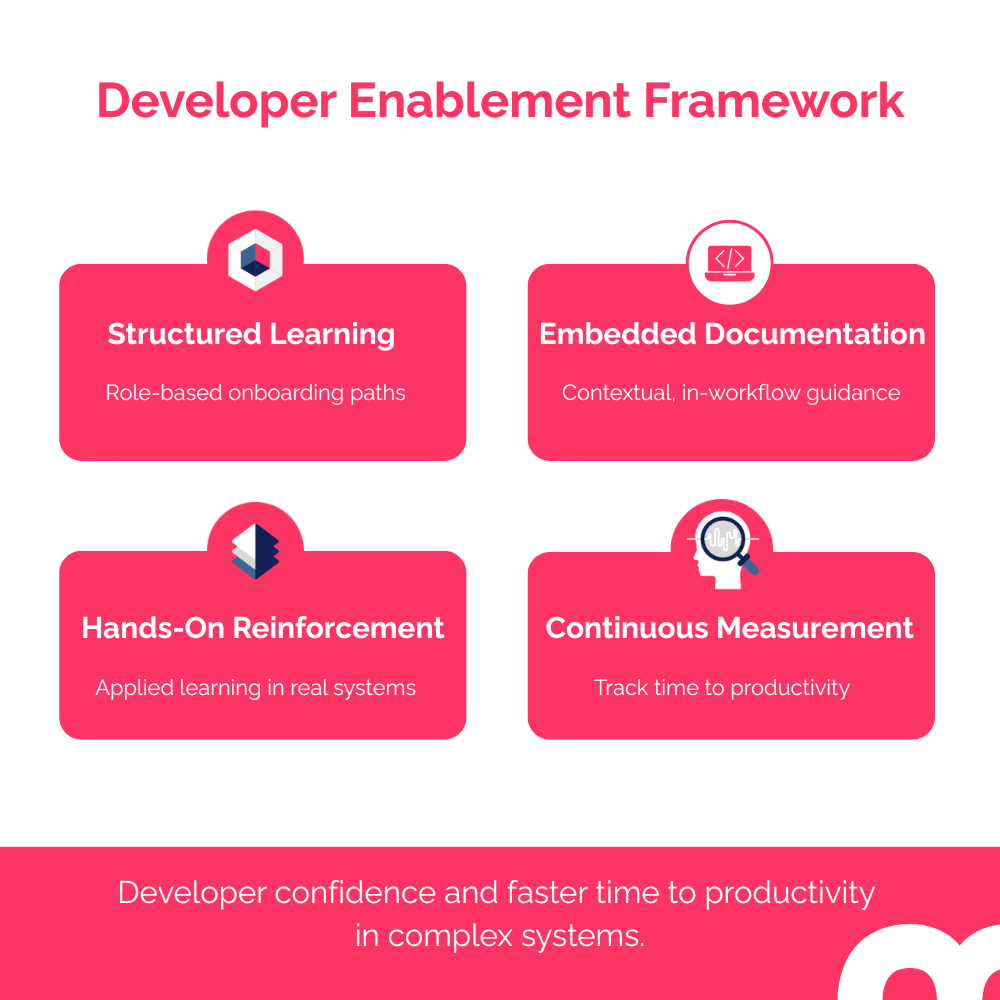
The best developer onboarding practices focus on:
This is where onboarding evolves into developer enablement.
To understand how this is applied in practice, see our approach to developer enablement
Onboarding is a starting point – not a complete solution.
Developer enablement extends beyond initial training to provide continuous support, reinforcement, and clarity.
This shift is essential for building developer confidence at scale.
Developer confidence is not just technical knowledge.
It’s the ability to:
Without structured enablement, confidence declines over time – especially in complex environments.
Clear, role-specific learning journeys help developers understand what they need to know and when. Learn more about practitioner-led programmes
Documentation should be integrated into workflows, continuously updated, and designed for real-world use. See how we support this through knowledge documentation systems
Developers build confidence through practical application, not passive learning. This is a core part of our specialist instruction services
Tracking time to productivity and performance ensures onboarding remains effective and scalable.
As financial organisations grow, complexity increases.
More systems. More teams. More dependencies.
Without structured onboarding and enablement:
With it:
Developer onboarding is only the beginning.
To reduce time to productivity and build high-performing engineering teams, organisations must go beyond onboarding and invest in developer enablement.
Because confident developers don’t just work faster – they build better systems.
If your organisation is struggling to reduce time to productivity or scale engineering capability, you’re not alone.
At Mallon Associates, we help teams move beyond onboarding to build real developer confidence in complex systems.
Explore our developer services and programmes → https://mallon.associates/services/
Or get in touch with our team → https://mallon.associates/contact/
Developer onboarding best practices include structured learning paths, embedded documentation, hands-on experience, and continuous measurement to ensure developers become productive quickly.
Financial services environments involve legacy systems, regulatory constraints, and complex dependencies, making onboarding more challenging and time-consuming.
Onboarding is a one-time process that introduces systems. Developer enablement is ongoing and focuses on building long-term capability and confidence.
By combining structured onboarding with continuous enablement, practical learning, and clear documentation, organisations can accelerate developer performance.
Developers often rely on surface-level knowledge of tools and frameworks, which makes it difficult to understand system behaviour in complex environments.

Michael Clarke is the Chief Executive Officer at Mallon Associates. With over two decades of experience, including deep technical expertise in C/C++, Java, and complex proprietary frameworks, Michael now focuses on technical leadership and scaling engineering operations for financial services firms. He is a recognised expert in developer onboarding strategy, dedicated to bridging the gap between high-level technology and sustainable business growth.