
Engineering insight
Who owns the knowledge when AI builds the system?
As AI changes how software is produced, engineering leaders need to know whether their teams can understand, maintain and evolve the systems they are responsible for.

I have spent more than 20 years at Mallon working with software engineers, initially as a technical trainer and later as a global lead instructor before becoming CTO. One thing has remained consistent throughout that time: understanding what code does is only part of being a good engineer. You also need to understand how it works, why it behaves that way and what might happen when you change it.
That understanding matters when engineers review work produced by someone else, whether that is a colleague, an external development team or an AI model. Code can be functionally correct, pass its tests and still contain problems that only become apparent when you understand what is happening beneath the surface.
As AI changes how software is produced, engineering leaders need to pay close attention to where that understanding sits, and whether their teams have the knowledge to take responsibility for the systems they build and inherit.
The gap between building software and owning it
AI-assisted development is already changing the volume and nature of software work.
GitHub’s October 2026 Octoverse report found that more than 40% of pull requests on its platform started with an agent’s first draft in September, up from 17% in March. That is a significant change in how developers are beginning work. It also puts more emphasis on the judgement applied when reviewing what an agent produces.
The figures describe activity on GitHub, rather than the entire software industry, but the direction is clear: agent-assisted development is becoming a substantial part of the workflow.
There is a related question for organisations using external specialists to build and deploy AI systems. In September 2026, Gartner predicted that 70% of enterprises would abandon agentic AI built through vendor forward-deployed engineering by 2028. Its concerns included rising costs and organisations struggling to evolve the systems independently.
These are different situations, but they point towards a shared issue. Producing a working system is one achievement. Developing the internal capability to understand and change it is another.
A working system is not necessarily an owned system
A system can be running successfully while much of the knowledge required to change it remains outside the organisation, or with a small number of individuals.
The team may know how to operate the system. They may understand its main functions and have documentation covering its components. But can they explain why a particular architectural decision was made? Do they understand the constraints that shaped it? Can they assess whether a proposed change will create problems elsewhere?
Those questions become more important as systems evolve.
An engineer making a change needs to understand the existing behaviour, the assumptions behind it and the dependencies that might be affected. Without that context, even a seemingly straightforward change can introduce risk.
The same applies to AI-generated code. A model can produce code that looks convincing, follows familiar patterns and passes the tests provided. The engineer reviewing it still needs enough understanding to recognise whether it is appropriate for the system in which it will run.
“We are the underwriters of every PR we approve.” Paul Storer-Martin
That is how I think about the responsibility of a software engineer. The tools used to produce code may change, but approving a change still carries responsibility for its consequences.
What engineering ownership actually requires
In my experience, developing that understanding involves several layers of knowledge. Documentation and training can contribute to each of them, but they need to address more than a description of what a system does.
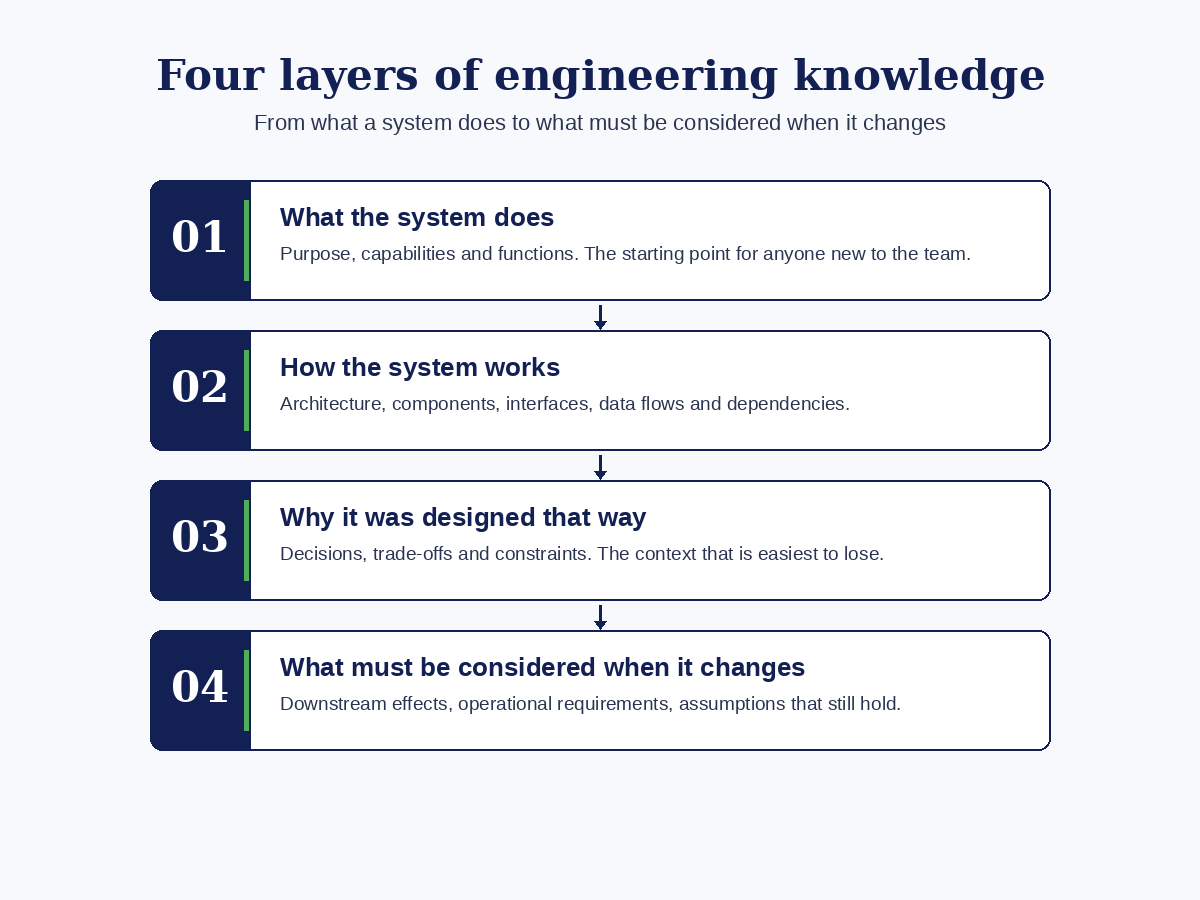
Four layers of engineering knowledge
1. What the system does
Engineers need a clear view of the system’s purpose, its capabilities and the functions it performs. This gives people a starting point when they join a team or need to work in an unfamiliar area.
2. How the system works
They also need to understand its architecture, components, interfaces, data flows and dependencies. This is the practical detail that helps an engineer trace behaviour through a system and understand how its parts interact.
3. Why it was designed that way
This is where important context can be lost. Why was one technology chosen over another? Why does a particular process work in a specific way? Which alternatives were considered, and what constraints influenced the decision?
The answers may sit with the engineers who originally designed or built the system. If those people move on, the reasoning can be much harder to recover than the technical implementation.
4. What could change, and what must be considered
Engineers need to understand the constraints around future development. A change that appears sensible in isolation may affect another component, a downstream process or an operational requirement.
This is where a mental model of the technology becomes particularly valuable. An engineer who understands how the underlying pieces fit together can reason about situations they have not encountered before. They are better placed to question assumptions, investigate unexpected behaviour and recognise when a change needs further consideration.
These layers are connected. A document can describe an interface accurately without explaining why it exists. A training course can teach a language or framework without covering the organisation-specific decisions that shape its use. A knowledge-transfer session can explain a design decision, but that understanding needs to remain accessible after the conversation.
Organisations need ways to capture and maintain this knowledge as systems and teams change.
The technology partner has a role in transferring ownership
External specialists can bring valuable experience, particularly when a system involves unfamiliar technology or complex integration. The important question is how that experience is shared during the engagement.
Knowledge transfer should be considered from the beginning, rather than left until a project is approaching completion.
That means involving the people who will operate and develop the system, giving them access to the relevant technical detail and explaining the decisions made along the way. It also means testing whether the internal team can use that knowledge independently.
Can an engineer explain how the system works? Can they investigate an issue without relying entirely on the external team? Can they make a change and understand its implications?
A handover document is useful, but it cannot demonstrate those capabilities on its own.
The same principle applies to training. Engineers need opportunities to work with the tools, processes and technical environment they will encounter in their roles. They should understand the reasoning behind the technology choices, including the restrictions and conventions that apply within their organisation.
The aim is to leave the organisation with more knowledge and capability than it had when the engagement began.
3Forge: building customer capability around a specialist platform
Our work with 3Forge provides a practical example of how technical learning material can support knowledge transfer around a specialist platform.
We worked with the 3Forge team to develop a substantial collection of learning resources for a global banking customer using the platform.
The first stage involved creating four bespoke introductory tutorials for people starting with no prior experience of 3Forge. Each tutorial guided the learner through building something real, supported by a written walkthrough and an introductory or follow-along video.
We then developed a series of 20 videos covering areas ranging from AMIScript fundamentals and advanced use to AMI Center, AMI DB, datasources, styling, plugins, AmiClient and realtime messages. Each video ran for approximately 15 to 25 minutes. Screen recordings, visual highlights and custom animations helped explain how data moved through the different layers of the platform.
The work also included developing a certification curriculum, exam questions and a testing and certification system.
The purpose was to give engineers a structured way to learn the platform’s fundamentals at their own pace. That changed the nature of subsequent live sessions. Rather than spending the time introducing basic concepts, instructors could focus more closely on specific use cases, architecture and difficult technical problems.
One of the banking customer’s reported outcomes was a 50% reduction in the effort required to onboard new engineers.
The work had another benefit. Developing the learning material required us to investigate the platform in considerable depth. That process surfaced behaviours and gaps in AMIScript that warranted further investigation by the 3Forge product team, including work by Robert Cooke and his colleagues.
It is also worth recognising that technical knowledge does not all age at the same rate. Core concepts may remain useful for years, while interfaces and faster-moving parts of a platform need periodic review. Learning material needs to reflect that difference if it is to remain useful.
This was not a library of videos on its own. It required a detailed understanding of the technology, a structured approach to explaining it and a way for engineers to demonstrate what they had learnt.
Measure the capability that remains
When assessing an AI or technology implementation, it is natural to look at delivery milestones, cost, functionality and time to deployment. Those measures matter, but they do not tell the whole story.
Engineering leaders should also consider the capability that remains within the organisation.
For example:
- Can engineers explain the architecture and the reasoning behind its important decisions?
- Can someone joining the team understand how the system behaves without relying entirely on the people who built it?
- Does the documentation explain constraints and dependencies, as well as functions and interfaces?
- Can internal engineers assess changes produced by AI tools or external development partners?
- Is important knowledge recorded and maintained when experienced people move to other roles or leave?
The answers help reveal whether the organisation can continue to develop the system independently, or whether too much of its understanding sits elsewhere.
This is particularly relevant when AI accelerates implementation. If the volume of code being produced increases, the ability to understand, review and maintain that code needs to keep pace.
For me, that comes back to how engineers learn. The most rewarding moment in a classroom is often when a student starts a sentence with, “So that means…” They have taken an idea, connected it to something else and begun to build their own mental model. They are starting to reason for themselves.
That is the kind of understanding organisations need to develop in their engineering teams.
If you would like Mallon to look at where this knowledge sits in your own organisation, start with a complimentary initial review.
Start by understanding where the knowledge sits
At Mallon, we have spent more than 30 years helping financial services organisations develop software engineering capability through practitioner-led programmes, technical documentation and knowledge transfer.
The starting point is understanding the technology, the people who work with it and the knowledge the organisation needs to retain.
If you are reviewing the documentation around a product, platform or system, we can begin with a complimentary initial review of the existing materials. We will agree the area to look at first, understand what is already available and identify where further documentation, knowledge transfer or training may be useful.
Depending on the system and the material, that initial assessment may also involve conversations with the engineers who work with it. We can then share practical recommendations, discuss potential next steps or scope further work where there is a clear need.
If you want to understand where critical technical knowledge sits in your organisation, talk to our team about an initial review.
Start with an initial review
If you want a clearer picture of the technical knowledge your organisation has documented, we can start by looking at an agreed product, platform or technology area.
We will discuss the material you already have, understand what your engineers need to know and identify where further documentation, knowledge transfer or training may help.
The initial conversation and assessment are complimentary. Any recommendations or potential next steps will be discussed with you, with no obligation to proceed.
We will use your details to respond to your enquiry. See our privacy policy.
Paul Storer-Martin
CTO, Mallon Associates
Paul is a working software engineer and the CTO of Mallon Associates. He has spent more than two decades teaching and building alongside engineering teams inside investment banks, fintechs and specialist technology firms.
References
- GitHub, Octoverse 2026: Commits, pushes, reach new highs as developers build with agents, 28 October 2026.
- Gartner, Gartner Predicts 70% of Enterprises Will Abandon Agentic AI Built by Vendor Forward-Deployed Engineering by 2028, 29 September 2026.
