
SUMMARY
In an era dominated by technology, automation and artificial intelligence, it’s easy to forget that learning isn’t just about imparting information efficiently. It’s about transformation. The world has become obsessed with applying technology to deliver things more quickly, and AI promises infinite process scalability and on-demand access. But while algorithms can replicate patterns, none can replicate the vital human traits of empathy, intuition and genuine mentorship.
Training – particularly in the complex, high-stakes world of software development in financial services – remains one of the few frontiers where the human element cannot, and should not, be removed or replaced.
The rise of AI-driven learning platforms has created an illusion: that effective training can be reduced to a sequence of automated modules and tick-box assessments. The reality is different.
Developers don’t learn well in a vacuum. They learn by watching, questioning, experimenting and receiving nuanced feedback from someone who understands, in the right context, what good looks like.
AI can track completion of an exercise and score a test. It cannot detect the furrowed brow of a developer struggling with the logic of an asynchronous system. It can’t adjust the pace of delivery when a class, or an individual, needs more explanation. It can’t provide the gentle reassurance that comes from an instructor who has been there, seen it, debugged it – who has recovered failed deployments and learned the lessons the hard way.
For Mallon Associates, this is the critical difference between training and enablement. Real learning doesn’t happen when someone clicks “Next”. It happens when someone says “oh, I get it now.”
The traditional developer training industry tends toward hard metrics: lines of code per hour, time to productivity, first commit, first PR, defect rates. These are valid measurements, but they’re only half the story.
The most effective training programmes also focus on the soft skills that underpin team performance: communication and trust, teamworking, problem-solving, confident collaboration.
When a developer joins a new team in a Tier 1 financial institution, they’re not just learning syntax. They’re learning the firm’s culture – the unwritten rules around how systems are built, tested, reviewed and deployed. These behaviours aren’t documented in a manual. They’re absorbed through observation and direct mentorship: seeing first-hand how senior engineers approach a problem, or deconstruct failure without blame.
This transfer of tacit knowledge – the why, not just the what – simply can’t be automated. It’s the social glue that turns coders into collaborators.
The shift to hybrid and remote working may have changed how training is delivered, but it doesn’t change what makes training work. Post-COVID, many firms tried to replace immersive learning with a combination of static e-learning modules and extended Zoom sessions. The results were predictable: fatigue, disengagement, poor knowledge retention.
Our approach addresses this directly and decisively. Mallon programmes are structured around what we call a “canonical day”, which blends live instruction, small-group tutorials and individual coaching. This balance of delivery and discussion keeps learners engaged and interactive, and better able to relate new knowledge to existing understanding.
We didn’t want students on Zoom for eight hours a day. We wanted them to learn, to think, and to do.
By integrating technology as an enabler, not a replacement, we keep learning dynamic and human-centred, even when delivered in hybrid formats.
Artificial intelligence is already enhancing the way developers learn. Adaptive platforms can assess skill gaps, recommend learning paths and even simulate coding challenges. Used well, these tools can accelerate comprehension.
Used poorly, they reduce learning to a solitary, transactional activity. And AI can get things wrong. Without a human in the loop, how do you verify that what you’re learning is correct?
The distinction lies in who holds the steering wheel. AI should support the mentor, not replace them. The best learning systems blend human judgment with automation, freeing instructors from repetitive admin while deepening their focus on coaching, analysis and feedback.
For us, that’s the philosophy behind Mallon’s practitioner-led enablement model. Our trainers use data and smart tools to measure engagement and comprehension, but they always anchor the experience in human interaction. Our instructors teach from experience, not from manuals.
Few sectors understand the importance of human-led learning better than financial services. Banks operate in highly regulated, mission-critical environments where mistakes carry consequences far beyond code errors. Training must therefore produce not just capable developers but confident ones – professionals who understand systems, controls and the rationale behind every process.
That kind of readiness can only be achieved through embedded, mentored learning. It’s why Tier 1 institutions have trusted Mallon Associates for over 30 years to train, coach and enable their developers across the globe.
In a technology-mad, machine-augmented world, human judgment remains a powerful differentiator. Teaching isn’t just about transmitting information. It’s about translating experience. It’s knowing when to challenge, when to pause and when to show rather than tell.
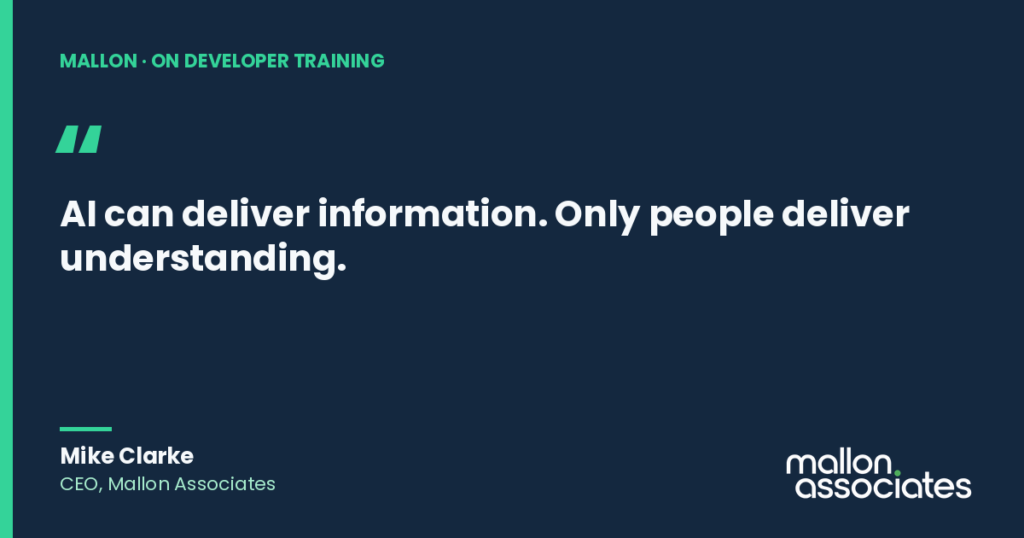
Technology can make learning faster and broader. But only people can make it meaningful.
The lesson, for us, is simple. AI may change, and indeed enhance, the tools of learning. But it cannot replace the vital human foundations of mentorship, empathy and lived experience. Embedded, practitioner-led learning remains the most effective way to build the highest standards of developer capability, confidence and culture, and to ensure every developer is productive on day one and every day after.
Want to talk to us about your developer enablement programme? We’ve spent over 30 years building practitioner-led learning for Tier 1 financial institutions. Get in touch.

Michael Clarke is the Chief Executive Officer at Mallon Associates. With over two decades of experience, including deep technical expertise in C/C++, Java, and complex proprietary frameworks, Michael now focuses on technical leadership and scaling engineering operations for financial services firms. He is a recognised expert in developer onboarding strategy, dedicated to bridging the gap between high-level technology and sustainable business growth.